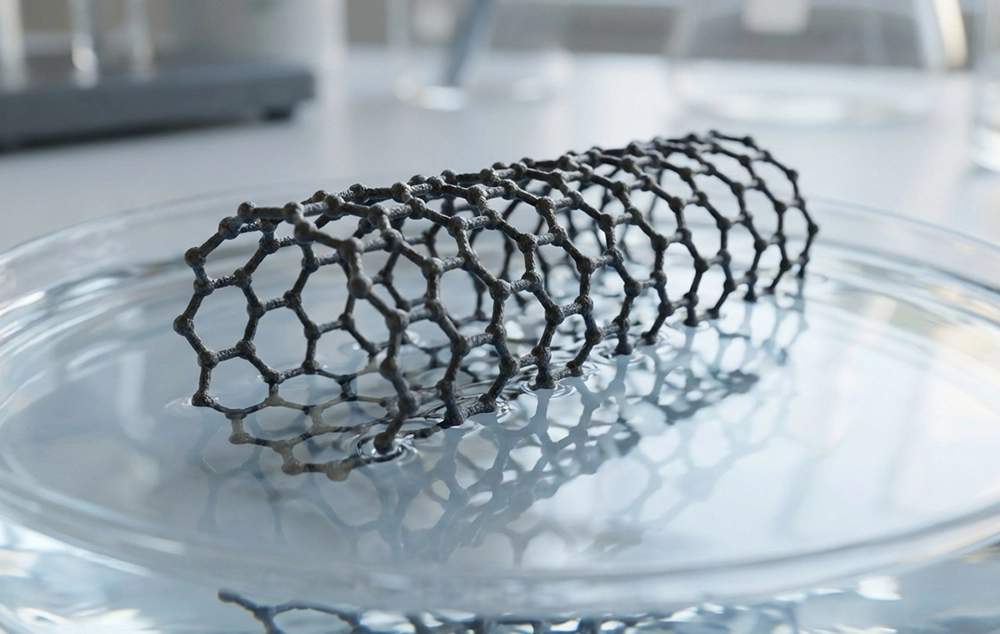
Carbon nanotubes (CNTs) are cylindrical carbon nanomaterials formed by rolling graphene sheets into tubes with diameters typically ranging from 1 to 100 nm. Carbon nanotubes exhibit extraordinary properties, including exceptional mechanical strength, high electrical conductivity, superior thermal conductivity, and large surface area. These characteristics position carbon nanotubes as transformative materials in applications ranging from structural composites and nanoelectronics to energy storage, sensors, and biomedical devices.
Carbon nanotubes possess complex 1-dimensional geometry with unique surface chemistry, which makes accurate visualization essential for understanding their atomic arrangement, defects, bundling behavior, and interactions with functional groups. Carbon nanotube 3D models serve as critical tools for communicating morphology, chirality, and functional modifications in scientific literature and engineering design.
Different types of carbon nanotube 3D models
a) SWCNT illustration
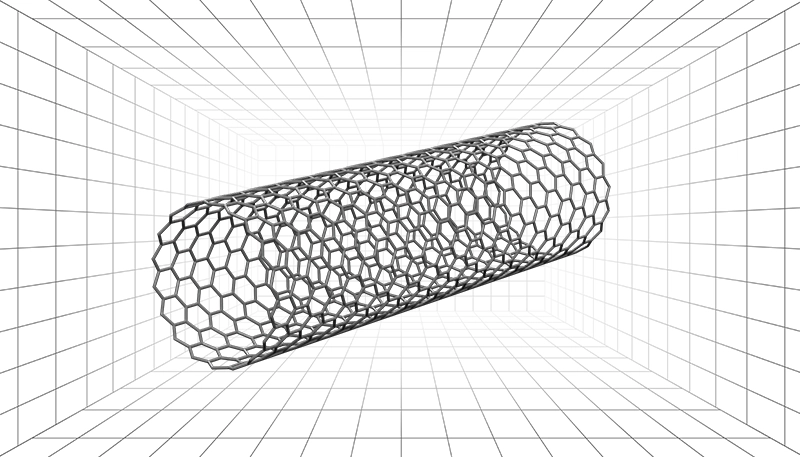

Single-walled carbon nanotubes (SWCNTs) are illustrated as smooth, hollow cylinders with thin and uniform walls, showing the subtle gradients and reflections to emphasize three dimensional volume of them. The hexagonal carbon lattice can be highlighted in a small zoom-in region while keeping the rest of the tube visually minimal for readability and a modern, high-tech look. Metallic palettes such as blues, silver, and neutral grays work well to support themes like nanoelectronics, sensing, and advanced materials.
b) MWCNT illustration
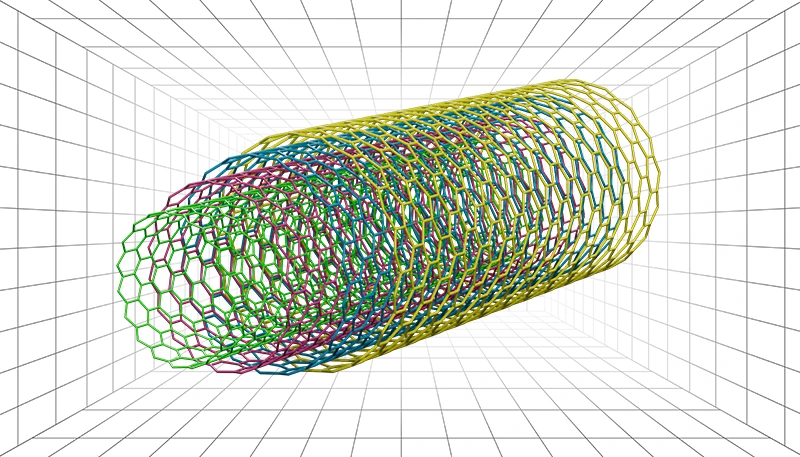
Multi-walled carbon nanotubes (MWCNTs) can be visualized as several tubes nested inside one another, often highlighted through cross-section images to show multiple circular walls within one another and to demonstrate the differences between layers. Semi-transparent outer shells allow inner tubes to be seen, which is effective for cover art and conceptual diagrams. Emphasizing thickness and layering helps communicate their enhanced mechanical and shielding properties in a visual way.
c) Carbon nanotube bundles and network illustration
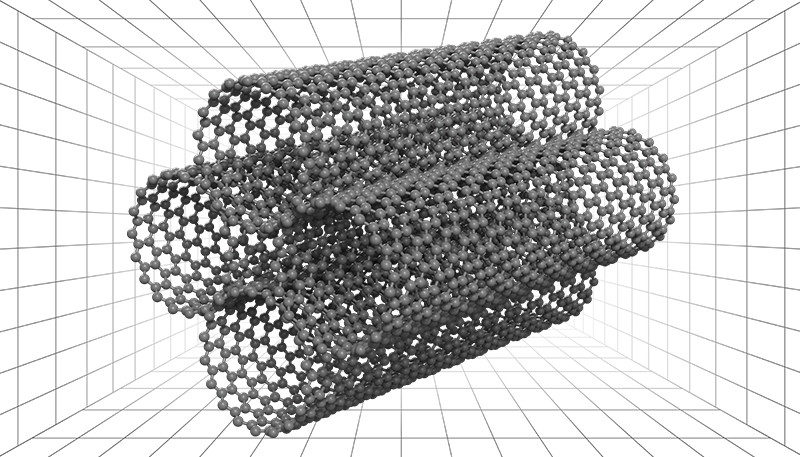
Carbon nanotubes frequently appear as rope-like bundles, random networks, or vertically aligned forests rather than isolated tubes, and these organizational motifs are visually powerful. Rope-like bundles suggest reinforcement and load transfer, random meshes are ideal for representing conductive films or filtration membranes, and vertically aligned forests growing from a substrate create dramatic compositions for posters and landing pages.
d) Graphene to carbon nanotubes illustration
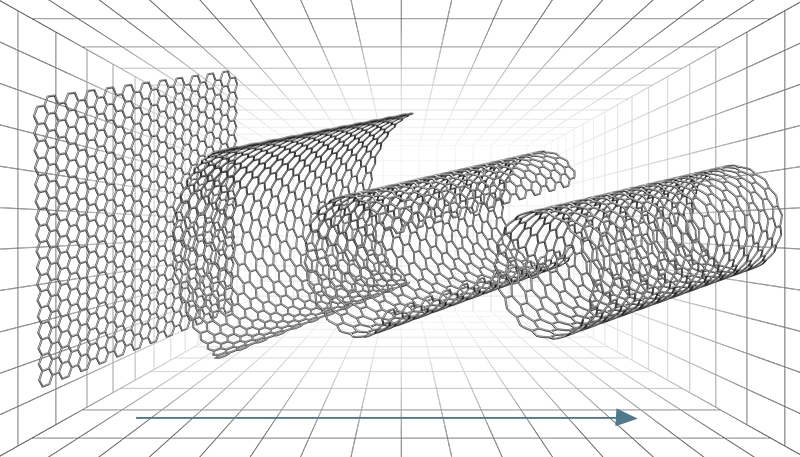
A particularly expressive model shows a flat graphene sheet smoothly rolling into a nanotube, either as a sequence or a single frame that combines flat and rolled regions. This approach is excellent for explaining the structural origin of carbon nanotubes for creating dynamic graphics or motion designs that transition from a 2D material to a 3D object.
e) Cross-section and cutaway illustration of carbon nanotubes

Cross-section and cutaway visuals focus on sliced or partially cut carbon nanotubes, highlighting the hollow interior and, for MWCNTs, multiple concentric walls. Combining a solid outer rendering with a local cutaway that reveals inner geometry or lattice is ideal for educational or explainer visuals where clarity of structure is critical. These illustrations work well in infographics, textbooks, and web explainers that need to communicate the hollow, layered tube structure of the carbon nanotube at a glance.
f) Functionalized and composite carbon nanotubes
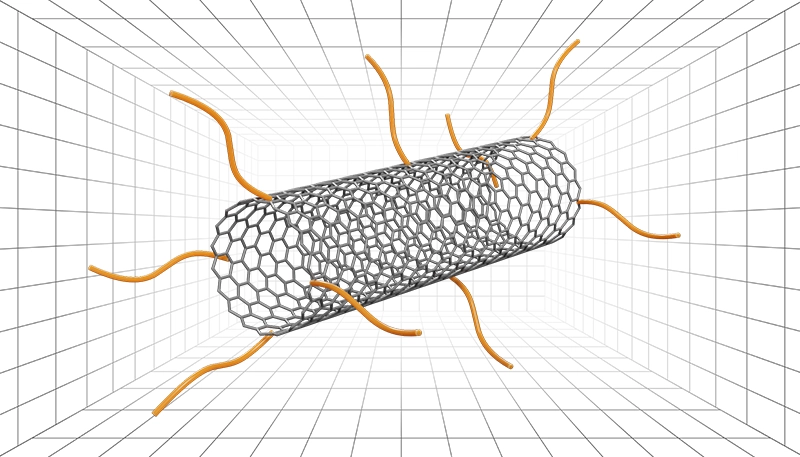
Surface modified carbon nanotubes can be illustrated in diverse visual styles that capture different functionalization without cluttering the core tubular geometry. For covalent modifications, small colored nodes or short chains can be shown attached directly to the sidewalls or concentrated at the open ends, as in diagrams that distinguish sidewall vs. end functionalization. Non-covalent approaches are illustrated by polymers or surfactants wrapping helically around the tube (like a coiled ribbon in contrasting color.
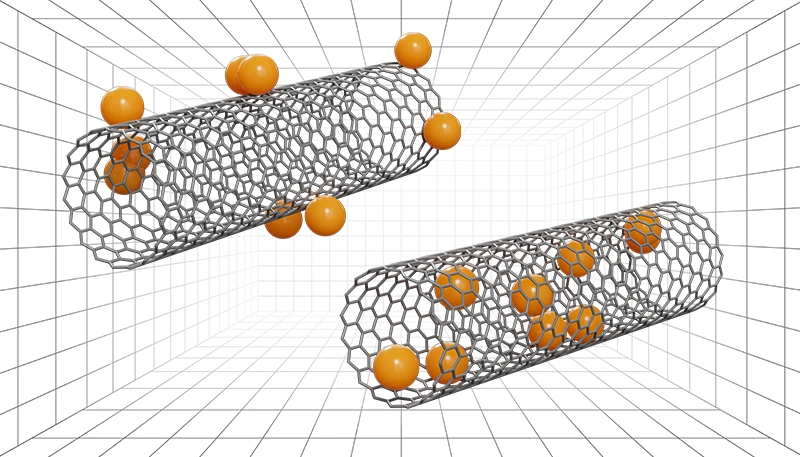
Functional groups can also be positioned creatively for specific stories, for instance, protruding outward from the surface to emphasize solubility or reactivity, filling the hollow tube to suggest encapsulation or drug loading, or densely packed along the length to show high coverage.
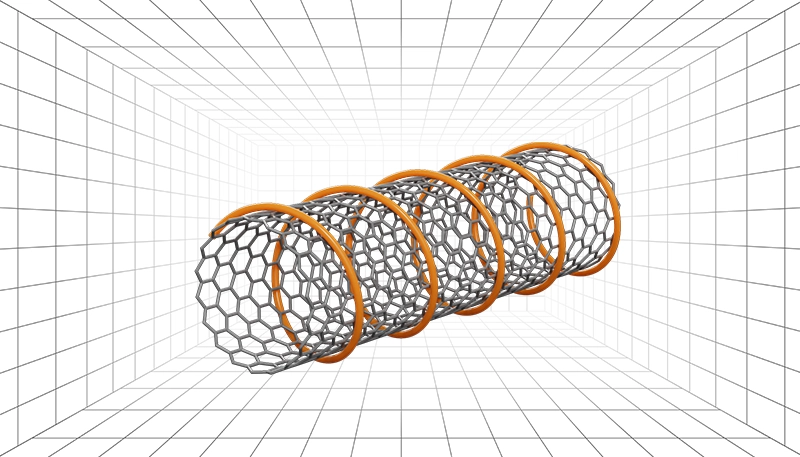
In composites, semi-transparent blocks or films showing CNTs dispersed randomly or aligned directionally inside a matrix, with local density and orientation tailored to the subject. Interface regions can be highlighted with color shifts or bridging elements to show load transfer or bonding, making these visuals perfect for material science infographics, device schematics, and biomedical applications.
g) Atomic vs continuum rendering of carbon nanotube 3D models
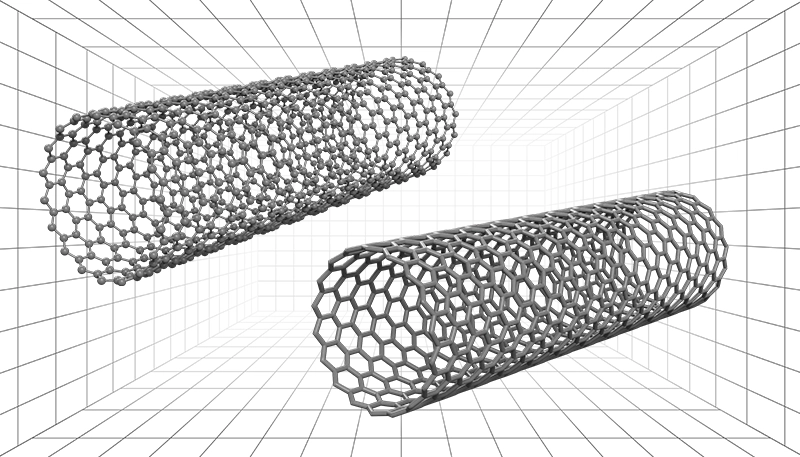
CNTs can be illustrated using ball-and-stick models where carbon atoms appear as spheres connected by rods to reveal the hexagonal lattice and atomic-scale details, ideal for emphasizing chirality or defects. Alternatively, smooth continuum surfaces treat the tube as a continuous, glossy cylinder with reflections and gradients, perfect for high-level device visuals and branding where atomic detail would distract.
h) Varied size and shape of carbon nanotube
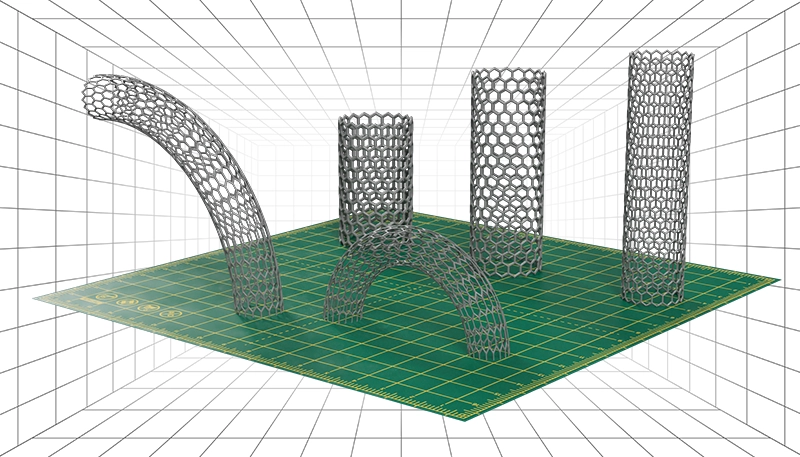
Carbon nanotubes can be shown short or long, thin or thick, straight or curved to reflect real material diversity. Uniform arrays suggest perfect synthesis; tangled networks show practical samples. These variations add visual interest while hinting at performance.
Study Fields Benefiting from CNT Illustration
Various study fields benefit from CNT illustration techniques. These fields include (but are not limited to):
- Materials Science & Composites
Atomic-level imaging reveals CNT dispersion, alignment, and interfacial chemistry in polymer matrices. Illustrations guide optimization of mechanical reinforcement and predict load transfer efficiency.
- Nanoelectronics & Sensors
CNT models distinguish metallic from semiconducting CNTs for transistors, interconnects, and various sensors. Defect visualization informs reliability and performance limits.
- Energy Storage (Batteries/Supercapacitors)
Illustrations depict CNT electrode architectures, porosity hierarchies, electrolyte wetting, and ion diffusion pathways. Radial breathing mode Raman maps guide purification for high-performance electrodes.
- Biomedical Applications
CNT illustrations visualize individualization, cellular penetration mechanisms, drug attachment sites, and scaffold architectures for tissue engineering and biosensing.
- Catalysis & Environmental Applications
Surface visualization highlights active sites, defect engineering for better reactivity, and pollutant adsorption geometries on CNT surfaces for water purification and gas sensing.
Scientific cover samples of carbon nanotubes


ACS Applied Materials & Interfaces, 2024, 16, 21, 27614–27626 (Cover created by Inmywork Studio)
The sample cover below shows successful incorporation of CNT within a composite for effective UV photodetection. CNTs are exhibited as long and flexible components of the composite, with vivid electrical effects, exhibiting their conductivity and structure. UV-light, illustrated with shiny purple color shins directly on the composite, and enables photo-induced detection.

Analytical Chemistry, 2022, 94, 28, 9941–9951 (Cover created by Inmywork Studio)
The cover art exhibits the use of fluorescent SWCNTs as biosensors. As it is illustrated, SWCNTs are functionalized with a detecting molecule. These molecules are located at designated parts of the fluorescent SWCNTs to show a rationalized functionalization. Light beams with vivid green and purple color indicates fluorescence, and highlight the use of SWCNTs in biosensing.

Nature Nanotechnology volume 18, pages177–183, 2023 (Cover created by Ella Maru Studio)
In the following cover art, we can see a close-up view inside a single carbon nanotube. This type of angle and view is used to emphasize on the molecule transportation inside of the nanostructure. The carbon nanotube is exhibited with silver-blue color and gently fades in the background as it continues. Clusters composed of water molecules and ions are shown with eye-catching colors, surrounded by gentle electrical sparks. Also, to indicate the fast movement, we can see a long trail behind these clusters. This cover depicts an isolated cluster inside a carbon nanotube, and explains the reason behind the potassium ions’ fast electrophoretic transport.

Nature Photonics volume 17, pages137–142, 2023 (Cover created by Chang Hee Nam lab)
The cover is showing hard X-rays being emitted from a carbon nanotube network, which has been illuminated with pulses from a petawatt laser. X-rays are shown as glowing and vivid light paths with eye-catching colors within the silver-colored carbon nanotubes network. As can be seen, carbon nanotubes are visible where the light is glowing, and gently disappear into the background and gradually fade. This cover is showing a new approach that may yield a new source of X-rays, which can be used in imaging and materials science.
How can I order 3D models of carbon nanotubes?
If you need professional 3D models of carbon nanotubes, you can contact Inmywork and use our services. Also, scientists and students can download free 3D scientific bundles like 3D models of Layers or 3D models of Nano roads and arrange them in Adobe Stager or Blender.
Recent Journal Cover Designs