
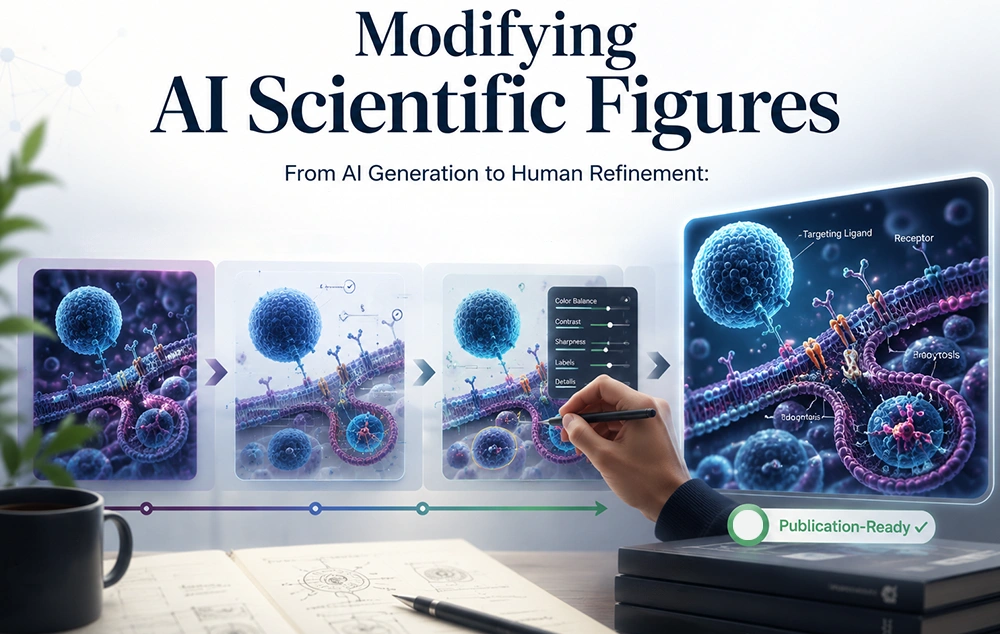
Artificial intelligence is changing the way researchers create scientific figures. AI image generators can produce impressive visual concepts in seconds, helping researchers explore ideas for graphical abstracts, scientific illustrations, diagrams, and educational content.
However, generating an image is only the first step. For scientific publications, a figure must do much more than look attractive. It needs to communicate the scientific concept accurately, use appropriate labels and visual elements, maintain consistency, and often meet specific publication requirements.
This is where human expertise remains essential.
Can AI-generated scientific figures be used directly?
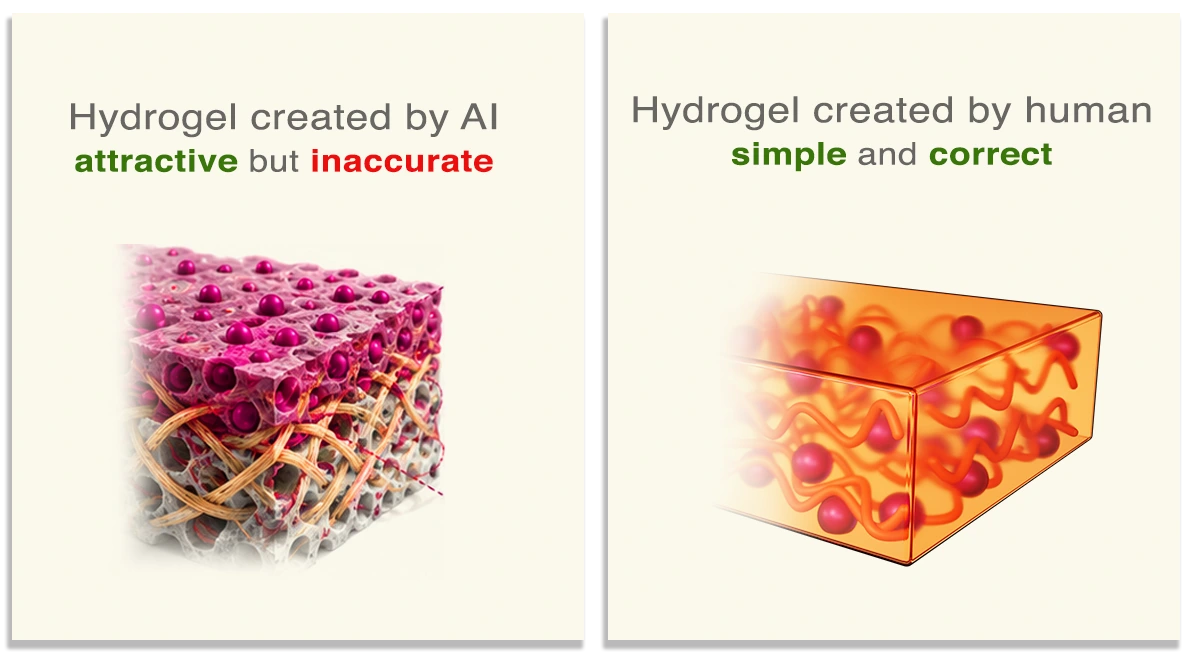
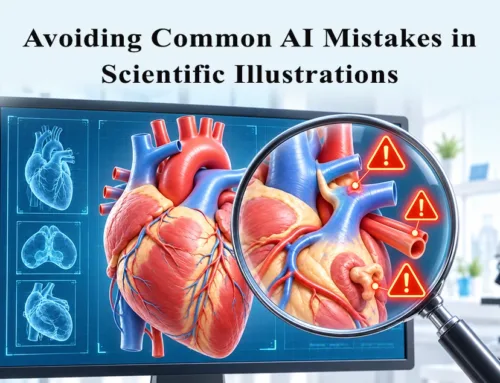
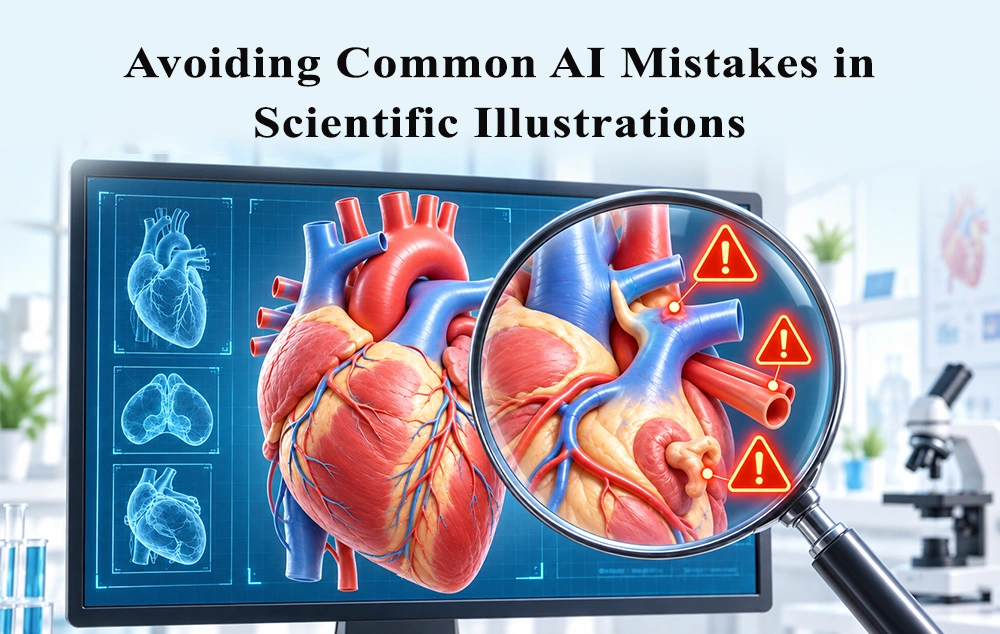
AI can help researchers develop an initial visual concept, but AI-generated figures should always be carefully reviewed by humans before use. For scientific communication, even a small visual error can change the meaning of a figure. An incorrect arrow, molecular structure, label, anatomical feature, or process can potentially mislead the reader.
Therefore, the most effective approach is often not AI versus human design, but rather AI plus human expertise.
Human discussion of AI graphical abstract generators identifies several challenges, including inaccurate scientific information, misleading visual elements, spelling errors, and difficulties when researchers attempt to modify an AI-generated image while preserving the original concept and composition.
Why do AI-generated figures often need human refinement?
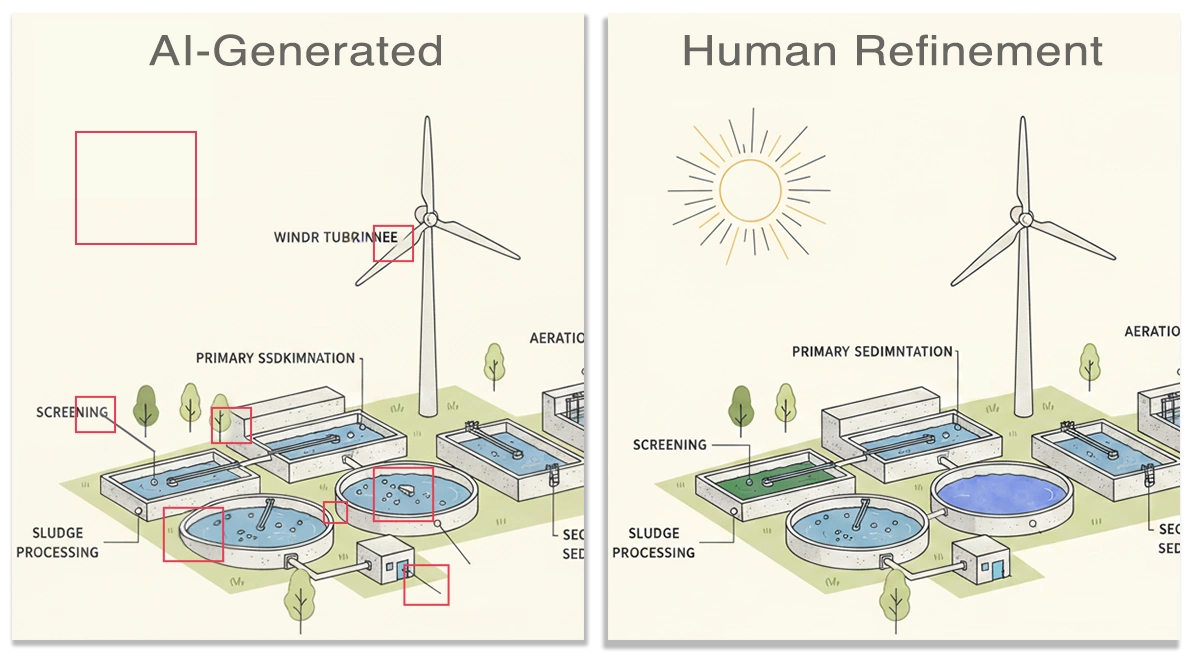
AI image generators are becoming increasingly capable, but scientific figures have requirements that differ from ordinary visual content.
1. Scientific accuracy
Scientific figures need to represent the underlying research correctly. An AI-generated image may look convincing while containing inaccurate structures, relationships, mechanisms, or other details.
Human review can identify these problems and ensure that the visual representation corresponds to the research.
2. Correct labels and typography
Text generation inside AI images can still produce misspelled words, distorted characters, or inconsistent typography.
For a research article, labels need to be clear and accurate. Human designers can replace problematic AI-generated text and establish a consistent typographic hierarchy.
3. Precise visual relationships
Scientific diagrams often depend on relationships between objects. Arrows, pathways, molecular interactions, experimental steps, and cause-and-effect relationships must communicate a specific meaning.
4. Consistent visual style
A manuscript may contain several figures that need to look like part of the same publication. Human refinement can help standardize fonts, line weights, colors, icons, proportions, layouts, and other visual elements across multiple figures.
5. Editable and professional artwork
Another challenge with AI-generated images is editability. Some AI-based academic illustration tools may not provide editable vector outputs, which can make later modifications difficult.
For publication workflows, researchers may need to adjust individual elements rather than regenerate the entire image. A professionally designed or reconstructed figure can provide much greater control over the final artwork.
From AI Concept to Publication-Ready Figure
A practical workflow can combine the speed of AI with the expertise of a scientific illustrator.
Step 1: Generate an initial concept
Researchers can use an AI image generator to explore different visual approaches. AI can be particularly useful during the brainstorming stage when the researcher wants to visualize a complex idea quickly.
Step 2: Check the scientific content
The generated image should be compared carefully with the underlying research.
Researchers should check:
- Scientific structures
- Experimental processes
- Labels and terminology
- Arrows and connections
- Quantitative information
- Anatomical or biological details
- Chemical structures
- Overall scientific interpretation
Step 3: Identify elements that need modifying AI scientific figures
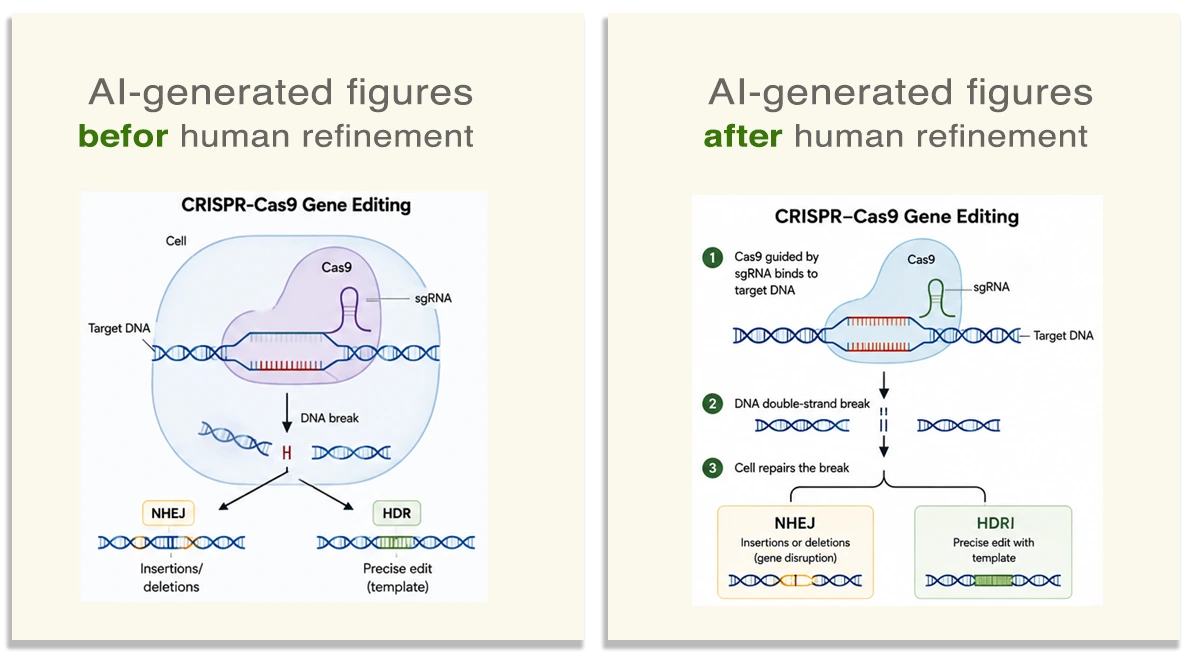
Not every part of an AI-generated image necessarily needs to be replaced. Some elements may simply require polishing, while others may need to be redesigned completely. This is where modifying AI scientific figures becomes valuable.
Step 4: Refine the figure professionally
Depending on the project, modifying AI scientific figures and human refinement may involve:
- Modifying arrows directions
- Adding labels and texts
- Improving typography or changing fonts
- Replacing inaccurate objects
- Adjusting colors
- Redrawing elements and molecules
- Reorganizing the layout and tables
- Improving visual hierarchy and composition
- Removing extra details
- Creating or modifying 2D or 3D objects
- Resizing figures for publication or presentation
- Correcting icons and symbols
The exact work required depends on the quality and complexity of the original AI-generated figure.
A Workflow for Researchers for modifying AI scientific figures by human refinement:
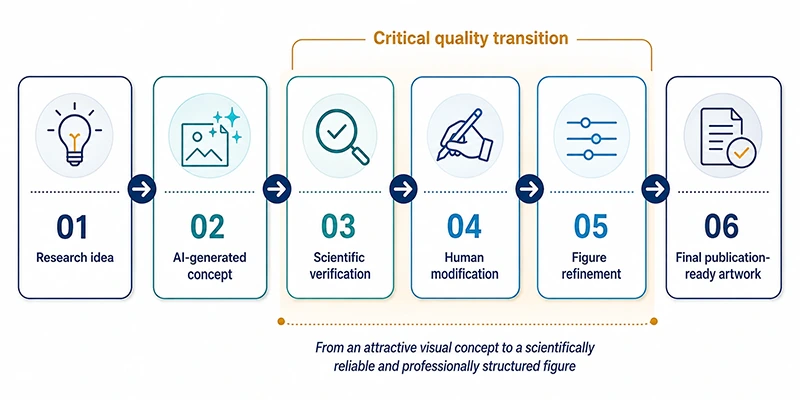
The most important stage is not necessarily the initial generation. It is the transition from an attractive visual concept to a scientifically reliable and professionally structured figure.
Research idea → AI-generated concept → Scientific verification → Human modification → Figure refinement → Final publication-ready artwork
Why do human scientific illustrators still matter?
The increasing use of AI does not necessarily reduce the need for scientific illustrators. Instead, it can change their role.
An AI system can generate visual possibilities, but a human expert can determine whether the result actually communicates the intended scientific message. This distinction is especially important in academic publishing.
We emphasize that scientific figures should communicate information effectively, maintain consistency, use appropriate visual cues, and present complex scientific concepts in a way that is understandable to the target audience. Human expertise is therefore valuable not only for artistic improvement but also for scientific communication.
What types of AI scientific figures can be modified?
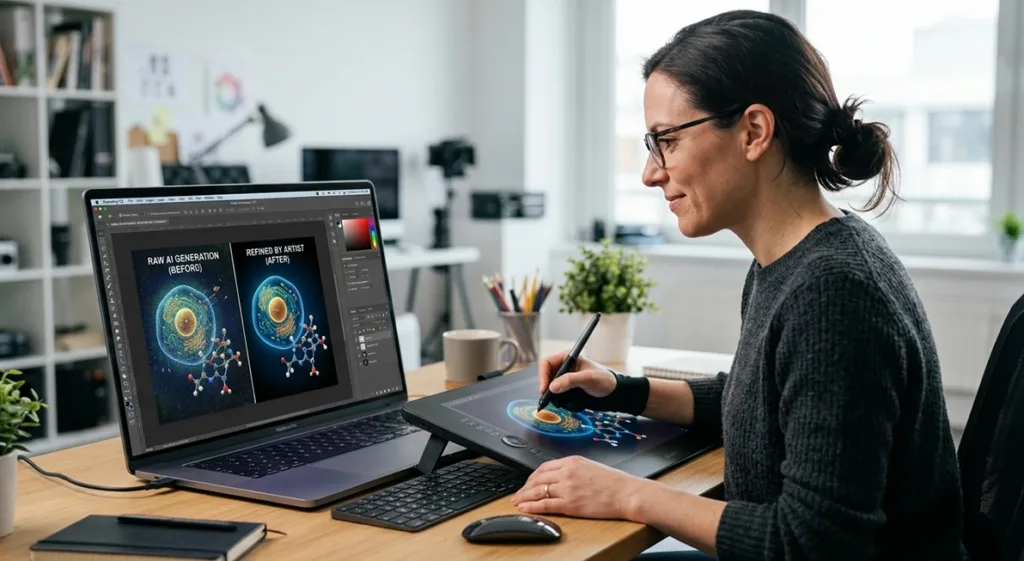
The appropriate workflow depends on the original image and the intended purpose.
Potential applications include:
- Graphical abstracts
- Scientific manuscript figures
- Medical and biological illustrations
- Journal cover artwork
- Conference posters and scientific presentations
- Scientific charts and plots
AI Should Be a Starting Point, Not the Final Step
One of the most useful ways to think about AI-generated scientific figures is as a starting point rather than a finished product.
So human designers can then focus on:
- Scientific accuracy
- Visual communication
- Detailed editing
- Consistency
- Publication requirements
- Professional presentation
This combination can provide a more practical workflow than relying exclusively on either AI or manual design.
How can the Inmywork team help refine AI-generated figures?
AI is becoming an increasingly useful tool for researchers who need to visualize scientific concepts. However, AI-generated figures can contain inaccuracies, problematic text, inconsistent visual elements, or editing limitations. For this reason, modifying AI scientific figures and human scientific refinement remain important.
Inmywork already offers professional AI-Generated figure modification and refinement services that are relevant to researchers who have generated an initial figure with AI but need greater accuracy, clarity, consistency, or professional quality. Clients can provide a sketch, an article abstract, or a straightforward explanation of their idea to help the team understand the project.
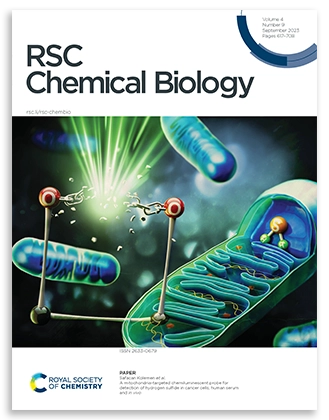
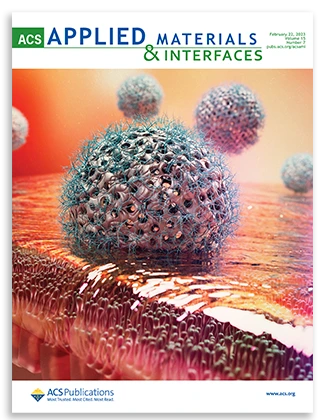
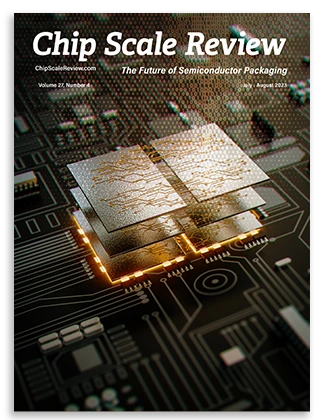
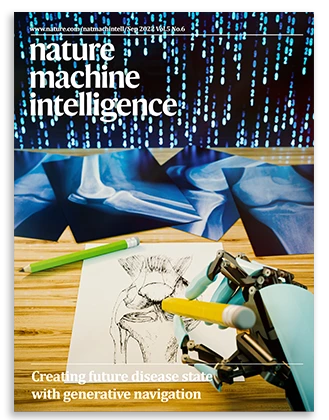
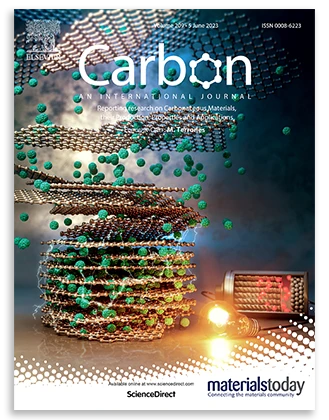
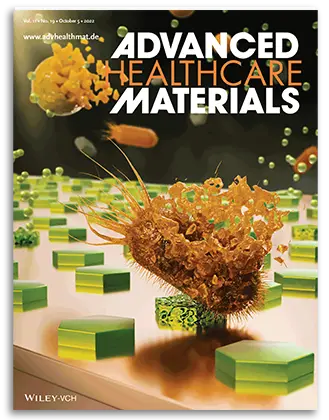
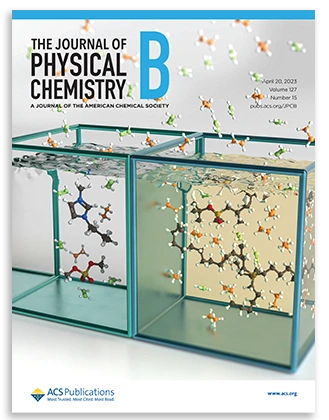
Recent Journal Cover Designs

Exactly, it is a challenge we usually face with. Sometimes new prompts for corrections take too much time.