


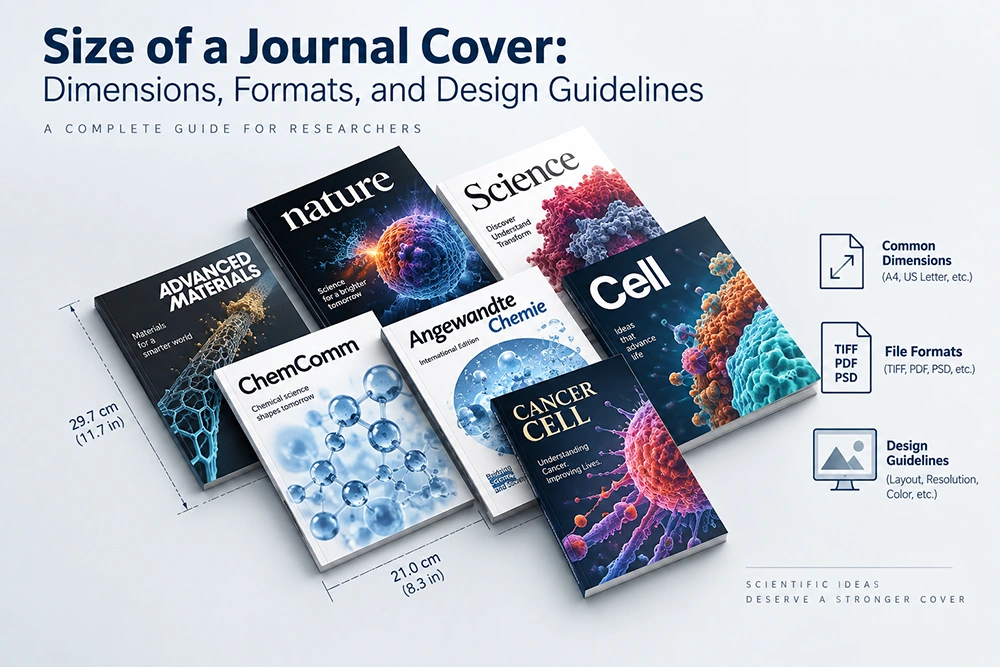
The size of a journal cover is one of the most important technical requirements when preparing artwork for a scientific publication. Whether you are designing a cover for a chemistry, biology, materials science, or medical journal, understanding the correct dimensions, image resolution, and file format is essential for producing professional, publication-ready artwork.
Scientific journal covers are more than decorative images. They visually communicate research discoveries, highlight scientific concepts, and help attract readers to published studies.
In this guide, we explain common journal cover dimensions, recommended image formats, resolution requirements, and practical design considerations to help researchers prepare high-quality scientific cover artwork.
What Is the Standard Size of a Journal Cover?
There is no universal size of a journal cover. Each scientific publisher and journal may establish its own dimensions, aspect ratio, and artwork layout.
For example, some scientific journal covers use portrait-oriented artwork that fills nearly the entire page, while others reserve space for the journal title, issue information, and publisher branding.
A journal cover measuring approximately 20.8 × 25.4 cm (width × height) is one example of a portrait format discussed in scientific cover design. However, this should not be considered a universal standard or a requirement for every ACS journal (Download ACS Cover Size Guideline).
Common Journal Cover Dimensions
| Cover size | Dimensions | Approximate pixels at 300 DPI |
|---|---|---|
| A4 | 21 × 29.7 cm | 2480 × 3508 px |
| US Letter | 8.5 × 11 inches | 2550 × 3300 px |
| Example portrait format | 20.8 × 25.4 cm | 2457 × 3000 px |
These dimensions are illustrative examples, not publisher-wide specifications. Always verify the exact artwork size and layout requirements provided by your target journal before beginning the design.
Why Does Journal Cover Size Matter?
Selecting the correct journal cover dimensions helps ensure that scientific artwork remains visually balanced, sharp, and compatible with the publisher’s production workflow.
Incorrect dimensions can cause several problems, including unwanted cropping, distorted scientific objects, insufficient space for journal branding, or reduced image quality during printing. (Read the Nature cover rules)
A properly sized scientific cover also allows designers to arrange molecular structures, biomedical illustrations, experimental devices, and other scientific elements without compromising the composition.
Scientific Journal Cover Layouts and Design Formats
Scientific publishers use different cover layouts depending on the journal’s visual identity and editorial requirements.
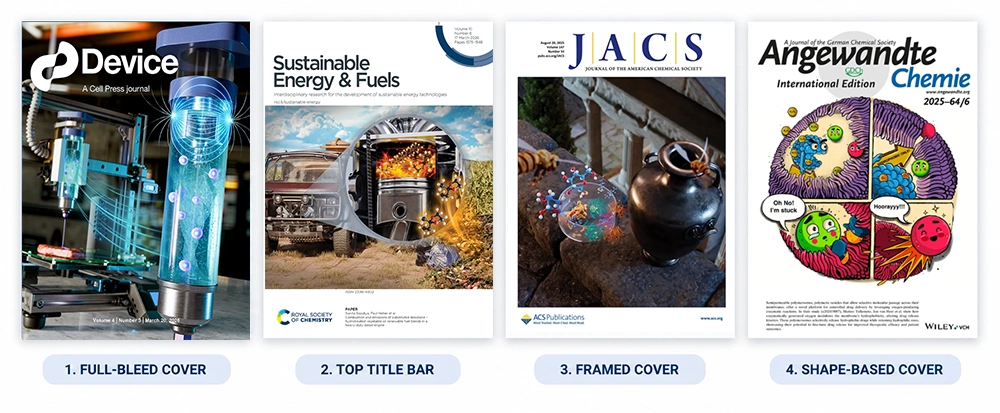

a) Full-Page Scientific Cover Design
In a full-page layout, scientific artwork extends across most or all of the cover area. The journal title and publication details may be placed over the image (Like the Advanced Materials family).
Designers should ensure that essential scientific elements on artwork are not positioned in areas reserved for text or editorial information.
b) Journal Covers with Reserved Title Space
Some journals require a dedicated area at the top of the cover for the journal name and publication information. (Like RSC journals)
In these cases, the main scientific illustration occupies the remaining space.
c) Centered and Template-Based Cover Artwork
Other journals use a smaller artwork region, a framed composition, or a specific geometric layout.
For example, certain cover formats may require artwork to fit within a centrally positioned region. (like ChemBioChem). In some others, the image is placed in a specific template. For example, images in the Angewandte Chemie Journal are circular and placed in the center of the cover.
d) Web Cover Without Printed Version
Some journals are published online only and do not feature regular cover art. The cover artwork is acceptable for the web page, and the aspect ratio is landscape (like the Nature Communications cover).
The journal’s official cover template should always determine the final composition.
What Resolution Is Required for a Scientific Journal Cover?
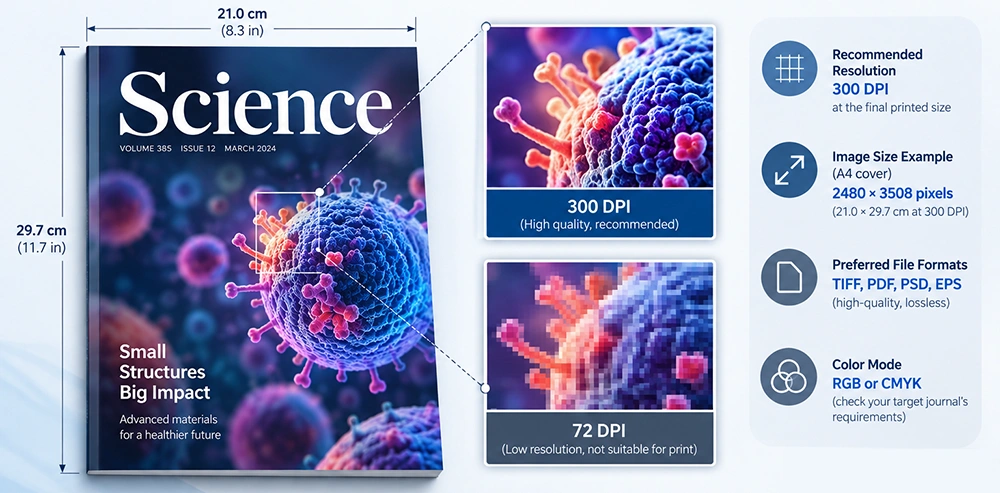

In addition to the size of a journal cover, image resolution plays a major role in print quality.
A resolution of 300 DPI is a common starting point for continuous-tone photographic and rendered artwork at its final printed dimensions.
However, publishers may require higher resolutions for line drawings, diagrams, or artwork containing fine text and technical details.
Recommended Image Preparation
- Resolution: Commonly 300 DPI for continuous-tone images, subject to journal requirements.
- Color mode: RGB or CMYK, depending on the publisher’s production specifications.
- Image dimensions: Match the journal’s requested final artwork size.
- Text and labels: Keep essential scientific annotations readable.
- Image quality: Avoid compression artifacts, blurred structures, and pixelated edges.
Do not automatically convert every scientific cover to CMYK. Some publishers prefer RGB artwork and handle color conversion during production.
Best File Formats for Scientific Journal Cover Artwork
Scientific journals may accept several image formats, depending on their submission and production workflows.
| File format | Main advantage |
|---|---|
| TIFF | High-quality raster artwork suitable for print production |
| PSD | Editable layered artwork for further adjustments |
| EPS | Vector-based illustrations and scalable graphical elements |
| Convenient for preserving combined text and graphics | |
| PNG | Lossless raster format for digital artwork |
| JPEG | Compressed image format for previews or permitted submissions |
TIFF, EPS, PDF, and other formats are frequently used in scientific publishing, but accepted formats vary between journals.
Before submitting your cover artwork, check whether the editorial team requires a flattened image, an editable source file, or both.
How to Design a Professional Scientific Journal Cover


A successful scientific journal cover should combine visual appeal with scientific accuracy.
The purpose of cover artwork is not simply to decorate a publication. It should communicate an important scientific idea and encourage readers to explore the associated research.
1. Highlight the Main Scientific Discovery
Identify the most important concept or finding in your research and make it the visual focus of the illustration.
For example, a cover illustrating a nanomaterial-based drug delivery system might emphasize the interaction between nanoparticles and a target cancer cell.
2. Maintain Scientific Accuracy
Molecular structures, biological processes, anatomical elements, and experimental devices should be represented accurately.
Avoid adding scientifically misleading details solely for visual effect.
3. Create a Balanced Composition
Arrange the scientific objects with a clear visual hierarchy. Use lighting, contrast, depth, and color to guide the reader’s attention toward the central research concept.
4. Follow the Journal’s Design Restrictions
Some journals restrict the use of logos, commercial branding, recognizable individuals, copyrighted imagery, or other specific visual elements.
These restrictions vary by publisher and should be checked before finalizing the artwork.
5. Prepare the Final Artwork for Publication
Before submission, verify the dimensions, resolution, color mode, accepted file format, and any requirements concerning editable layers or supporting documentation.
Software Used for Scientific Journal Cover Design
Professional scientific cover artwork often combines several illustration and visualization techniques.
Three-dimensional modeling software can be used to create molecular structures, laboratory equipment, and realistic scientific environments.
Raster graphics applications help refine lighting, textures, color balance, and image composition.
Vector graphics software is useful for preparing scalable annotations, graphical elements, and precise scientific labels.
Combining these approaches allows designers to create detailed scientific covers while maintaining control over the final image quality and layout.
Frequently Asked Questions About Journal Cover Size
What is the standard size of a journal cover?
There is no single standard size for all scientific journals. Cover dimensions vary depending on the publisher, journal layout, and artwork requirements. Always follow the specifications of the target journal.
What is the size of a journal cover in pixels?
The pixel dimensions depend on the physical cover size and required resolution. For example, an 8.5 × 11-inch cover at 300 DPI measures 2550 × 3300 pixels.
Is 300 DPI enough for a scientific journal cover?
A resolution of 300 DPI is commonly suitable for continuous-tone images at their final printed size. However, line art and other technical graphics may require higher resolution.
Should journal cover artwork be RGB or CMYK?
The correct color mode depends on the publisher. Some journals accept or prefer RGB files, while others specify CMYK. Follow the official artwork guidelines.
Can I use a 3D illustration for a scientific journal cover?
Yes. Three-dimensional scientific illustrations are widely used to visualize molecular interactions, biomedical mechanisms, materials science concepts, and complex research findings, provided they meet the journal’s requirements.
What is the difference between a journal cover and a graphical abstract?
A journal cover is designed for the visual presentation of a publication issue and often emphasizes artistic composition. A graphical abstract provides a concise visual summary of a specific research article, typically following a more information-focused layout.
Professional Scientific Journal Cover Design by INMYWORK
Preparing scientific cover artwork requires both technical precision and creative scientific visualization.
At INMYWORK Studio, we provide professional scientific journal cover design services for researchers working in chemistry, biology, medicine, nanotechnology, materials science, and related disciplines.
Our design process considers the scientific concept, visual composition, and technical artwork specifications required by the target journal.
Whether you need a molecular illustration, biomedical visualization, or detailed 3D scientific composition, our team can help transform your research into compelling journal cover artwork.
Explore our professional scientific journal cover design services and prepare your research artwork for publication.
Conclusion
Understanding the correct size of a journal cover is an essential first step in preparing professional scientific artwork.
Although journal cover dimensions vary between publishers, following the required image size, resolution, file format, and layout specifications helps avoid unnecessary revisions and production problems.
By combining accurate scientific visualization with thoughtful composition and the journal’s technical guidelines, researchers can create visually engaging cover artwork that effectively communicates their scientific discoveries.