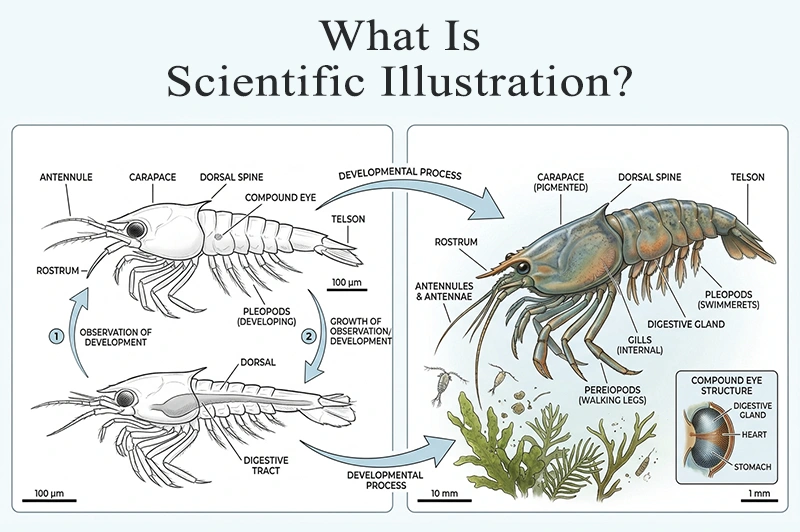
Art plays an important role in the development of science and in how information is shared. The field of scientific illustration brings art and science together. You may remember your school textbooks or the poster you saw at the doctor’s office. All of them are scientific illustrations.
Scientific illustration is the practice of creating accurate visual representations of scientific subjects to communicate complex information clearly and effectively. Unlike decorative artwork, scientific illustrations prioritize scientific accuracy while remaining visually engaging. They help researchers, educators, medical professionals, and students understand structures, mechanisms, organisms, and processes that are difficult to explain with text or photographs alone. Most students don’t know what scientific illustration is, and we answer this question completely in this article.
What is the application of scientific illustration?
The purpose of this is to convey complex scientific concepts, details, and subjects in an easy-to-understand way. Moreover, scientists can come up with great ideas when they imagine dimensions and structures such as molecules, cells, and textures. Nowadays, some scientific articles in fields like biology, chemistry, and materials engineering couldn’t be imagined without any scientific illustrations. In a nutshell, scientific illustration is an art form that supports science.
In modern research, scientific illustrations appear in:
- Scientific journal articles.
- Graphical abstracts.
- Medical textbooks.
- Conference posters.
- Educational materials.
- Museum exhibits.
- Pharmaceutical marketing.
- Research presentations.
Today, both 2D vector illustrations and 3D scientific renderings are widely used in academic publishing and science communication.
What Makes Scientific Illustration Different from Regular Illustration?
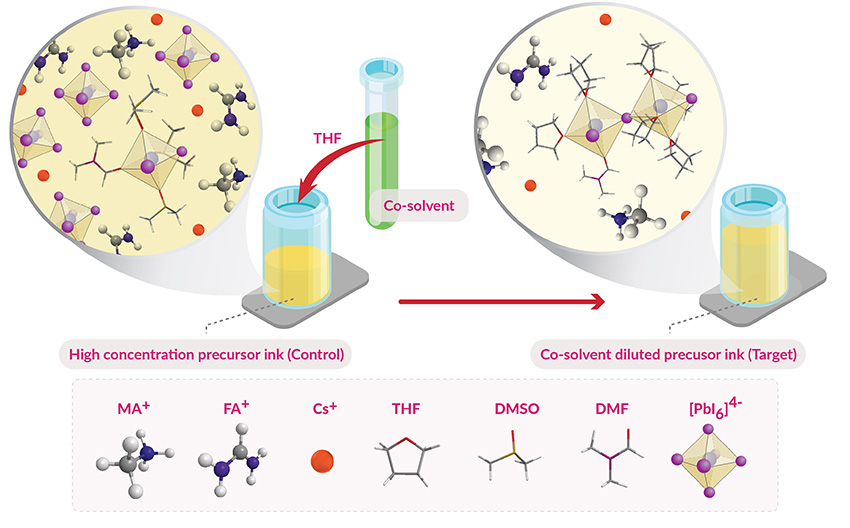

2D TOC was designed by the Inmywork team. Nature Communications, volume 13, Article number: 89 (2022).
Many people ask: What is scientific illustration, and how is it different from normal illustration?
The answer lies in its purpose. Scientific illustration is designed to communicate factual information rather than artistic expression.
| Scientific Illustration | Regular Illustration |
|---|---|
| Based on scientific evidence. | Based on artistic interpretation. |
| Accurate proportions and details. | Creative proportions allowed. |
| Explains biological or scientific concepts. | Tells stories or creates visual style. |
| Includes labels, arrows, legends, and annotations. | Labels are optional. |
| Used in journals, education, and healthcare. | Used in books, advertising, entertainment, and branding. |
A scientific illustration may look beautiful, but sometimes beauty is secondary to clarity and scientific correctness.
Why Is Scientific Illustration Important?
Scientific illustration bridges the gap between complicated scientific data and human understanding.
Benefits of scientific illustration include:
- Simplifies difficult scientific concepts.
- Improves communication between scientists.
- Helps journals present research visually.
- Makes educational content easier to understand.
- Increases engagement with scientific publications.
- Supports science outreach and public education.
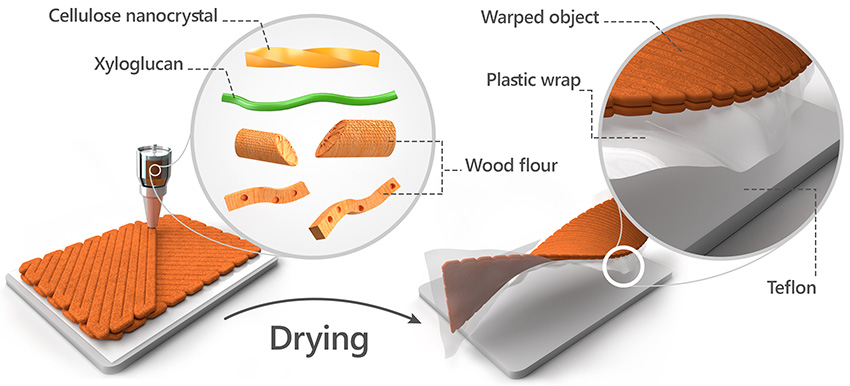

A 3D graphical abstract created by the Inmywork team.
Studies and scientific organizations emphasize that visual communication improves comprehension of complex scientific information, especially when explaining invisible or microscopic processes.
Types of Scientific Illustration
Scientific illustration covers many scientific disciplines.
1. Medical Illustration
Medical illustration explains human anatomy, diseases, surgeries, organs, tissues, and physiological processes.
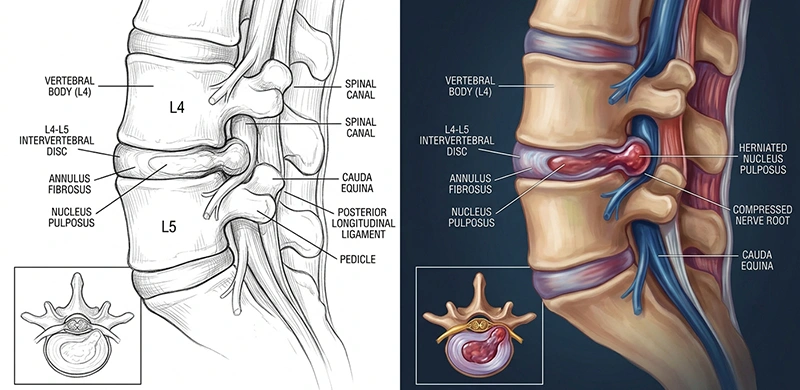

Applications
- Medical textbooks.
- Patient education.
- Surgical training.
- Pharmaceutical companies.
- Medical journals.
Medical illustration is considered one of the largest professional branches of scientific illustration.
2. Biological Illustration
These illustrations are common in molecular biology and life science publications.
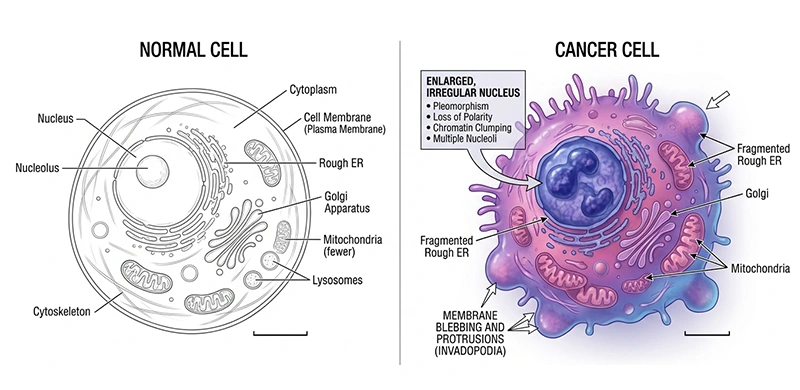
Biological illustrations visualize:
- Cells.
- Proteins.
- DNA.
- Viruses.
- Bacteria.
- Molecular pathways.
- Biotechnology processes.
3. Botanical Illustration
Botanical illustration accurately depicts plants, leaves, flowers, seeds, roots, and plant anatomy.
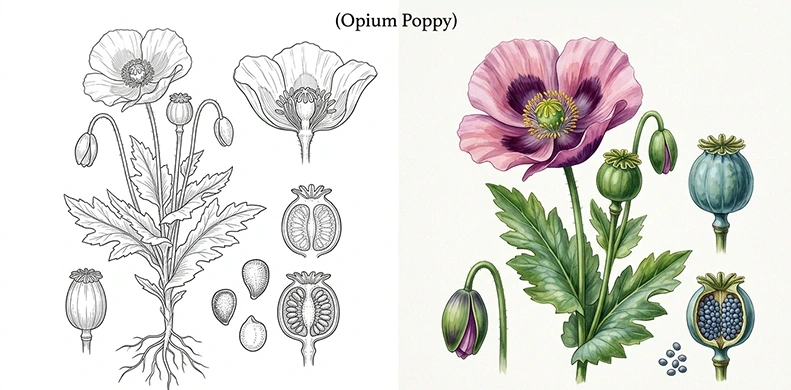

Common uses include:
- Taxonomy.
- Field guides.
- Botanical research.
- Agriculture.
- Ecology.
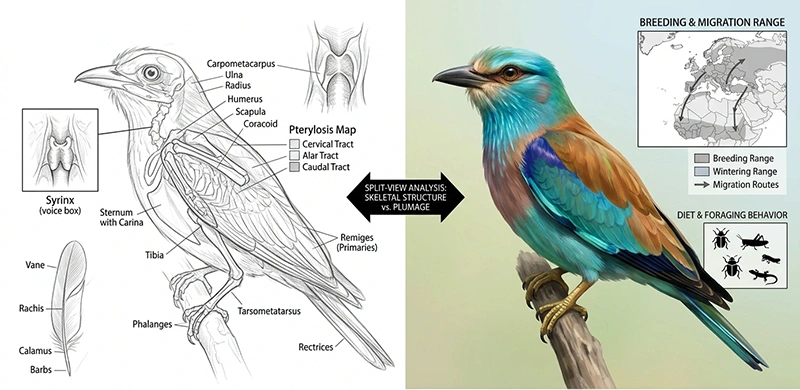
4. Zoological Illustration
Zoological illustrations help scientists identify species and communicate anatomical differences among animals.
5. Chemical Illustration
These images are frequently used in graphical abstracts and journal covers.
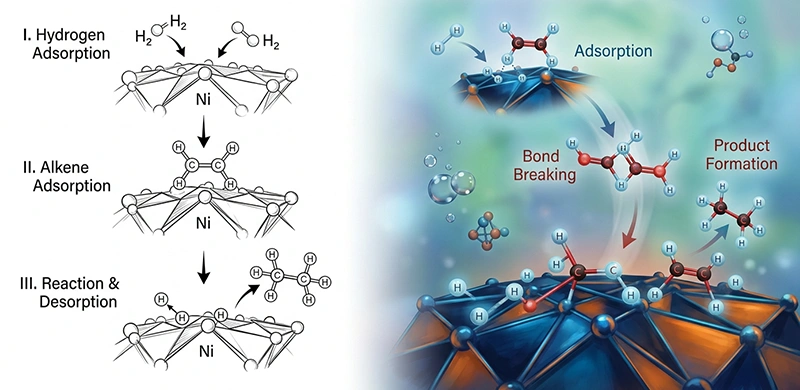
Chemistry illustrations visualize:
- Molecular interactions.
- Chemical reactions.
- Nanomaterials.
- Catalysts.
- Polymer structures.
- Energy transfer.
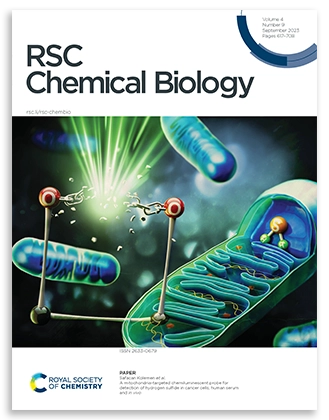
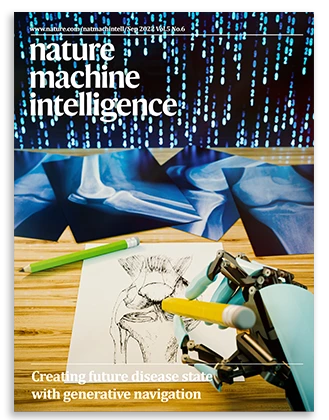
6. Scientific Journal Cover Illustration
Journal covers combine scientific accuracy with artistic storytelling.
Researchers often commission illustrations to highlight significant discoveries published in scientific journals.
Who is a scientific illustrator?
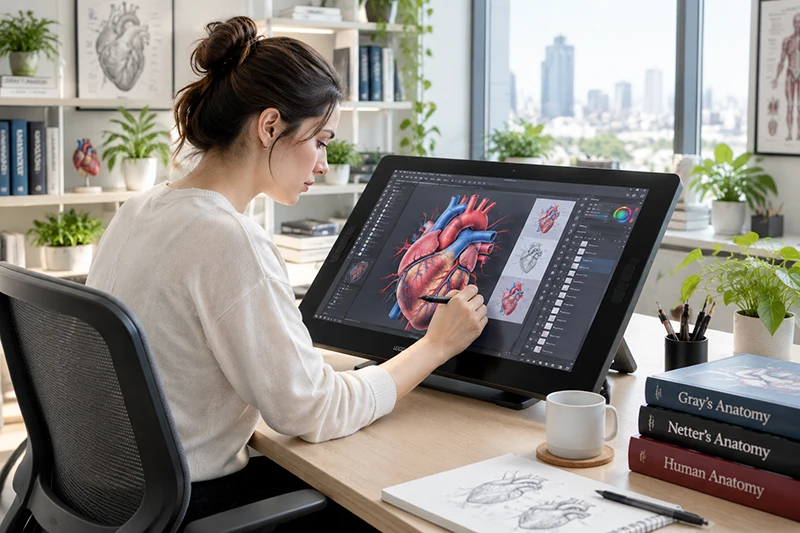

These artists have both knowledge of science and art, and they can render images of scientific subjects that convey information effectively. To make the topics accessible and engaging to audiences of all levels, illustrations provide visual explanations and depictions. The ability to discuss with scientists in various fields and understand them is another feature of scientific illustrators. By helping scientific artists, complex topics can be explained to the general public in a simple way.
Two main international organizations work to connect these artists:
The most popular and largest type of scientific artwork is medical illustration. Hundreds of scientific and medical illustrators from around the world attend this group’s annual conference. Medical illustrators depict surgical procedures, internal anatomy, and biological processes.
What Does a Scientific Illustrator Do?
A scientific illustrator combines knowledge of science with artistic and technical skills.
Responsibilities include:
- Reading research papers.
- Discussing concepts with researchers.
- Understanding experimental results.
- Sketching concepts.
- Designing publication-ready figures.
- Creating 2D or 3D scientific illustrations.
- Revising artwork according to journal guidelines.
Scientific illustrators often collaborate directly with scientists to ensure visual accuracy.
How Scientific Illustrations Are Created
Creating a professional scientific illustration involves several stages.
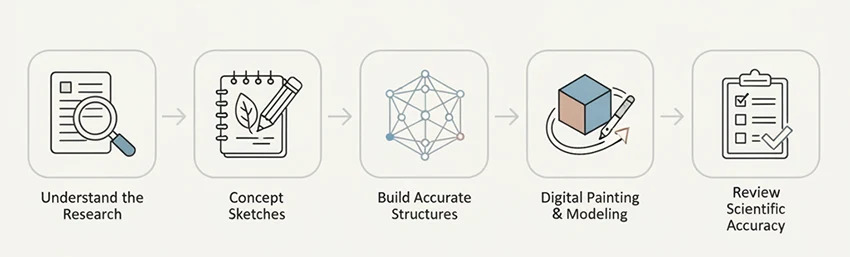

Step 1 — Understand the Research
The illustrator studies:
- Research manuscript.
- Experimental methods.
- Figures.
- Supporting information.
- References.
- Abstract of the article.
Step 2 — Create Concept Sketches
Initial sketches determine composition and storytelling. Sometimes it takes 3 or 4 days to catch an idea.
Step 3 — Build Accurate Structures
Illustrators redraw molecules, cells, organs, or devices using scientific references.
Step 4 — Add Color, Depth, Digital Painting, and 3D Modeling
After confirming the sketch and primary idea by the authors, the illustrator proceeds in the illustration in 2D or 3D.
It will continue with:
- Digital painting
- 3D modeling
- 2D modeling
- 3D and 2D composition
- Reorganizing the scientific objects
Step 5 — Review Scientific Accuracy
Scientists verify:
- Labels.
- Arrows.
- Colors.
- Scale.
- Mechanisms.
The final artwork is exported according to journal specifications and standard size.
3D vs 2D Scientific Illustration
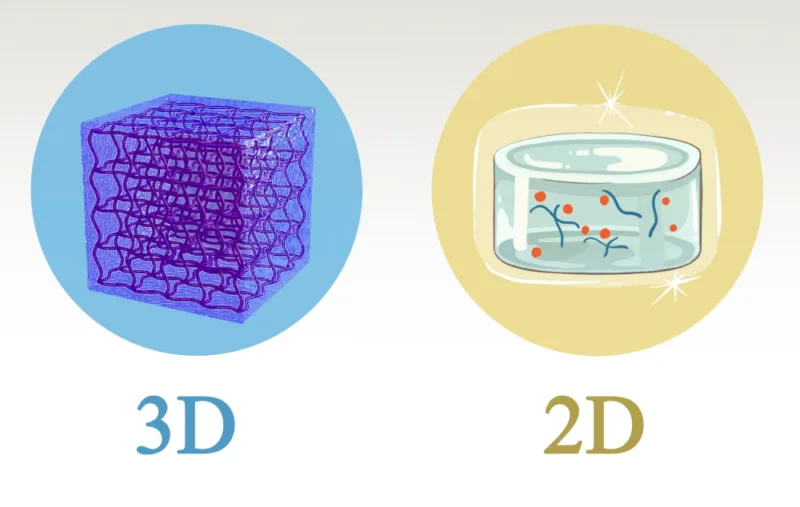

| 2D Scientific Illustration | 3D Scientific Illustration |
|---|---|
| Flat vector artwork. | Realistic depth and lighting. |
| Easy to print. | Ideal for journal covers. |
| Educational diagrams. | Molecular and medical visualization. |
| Flowcharts and mechanisms. | Animations and interactive visuals. |
How Scientific Illustration Helps Researchers Publish Better Papers
High-quality figures can improve the presentation of scientific research.
Scientific illustrations help researchers:
- Explain mechanisms clearly.
- Increase visual impact.
- Improve reader understanding.
- Meet journal graphical abstract requirements.
- Create memorable journal cover artwork.
Many journals encourage authors to include graphical summaries and high-quality visual figures alongside manuscripts.
Can AI Create Scientific Illustrations?
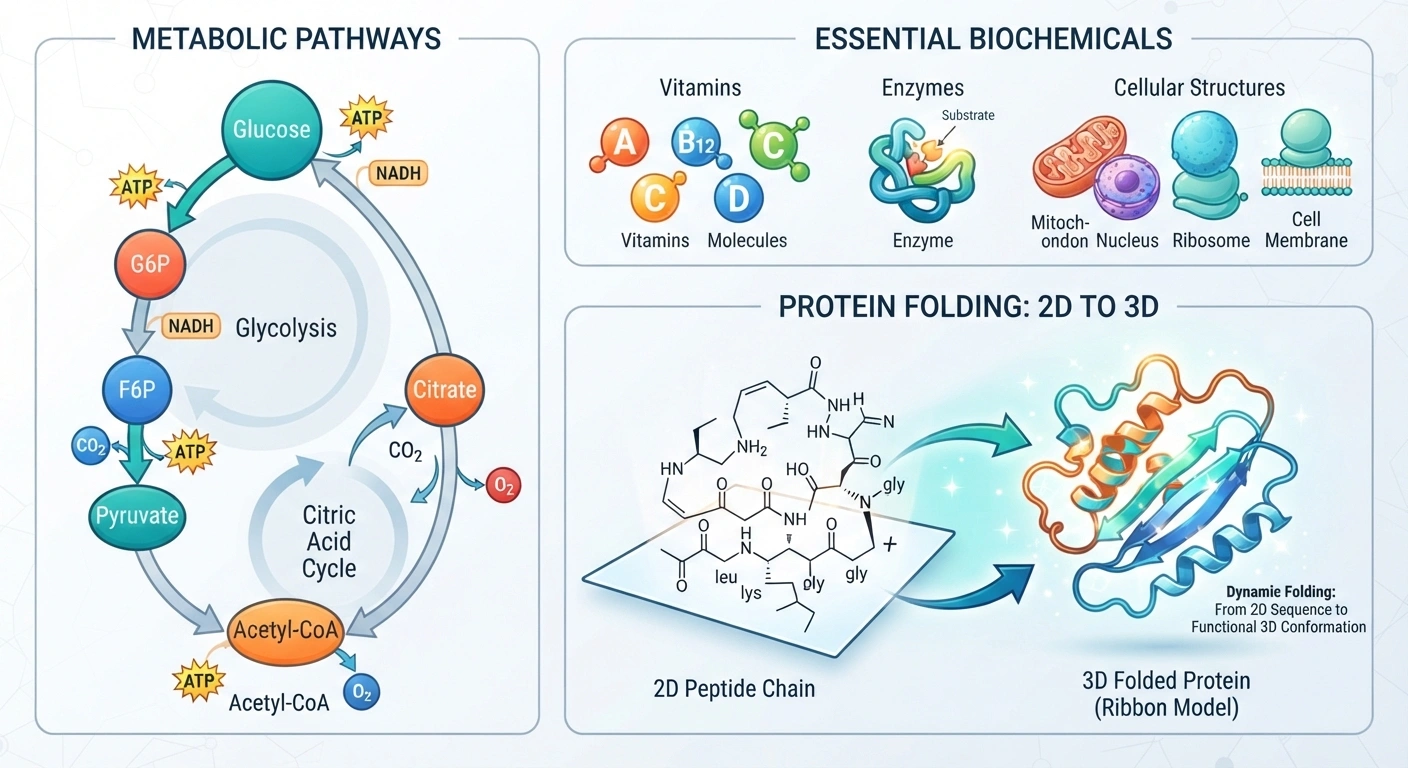

A scientific figure generated by AI
Artificial intelligence has changed the workflow for scientific figures, but AI-generated illustrations still require expert review.
AI can help with:
- Brainstorming concepts.
- Creating draft compositions.
- Generating visual ideas.
- Making several figures in a short time
Human illustrators remain essential for:
- Scientific accuracy.
- Correct molecular structures.
- Anatomical correctness.
- Journal formatting.
- Label verification.
AI is best viewed as a starting point; however, it can be used to work on simple graphical abstracts and manuscript figures. There are 12 AI mistakes in scientific illustrations that authors must avoid (Click here to read the article)
Frequently Asked Questions About Scientific Illustration
Scientific illustration is the creation of accurate images that explain scientific subjects, processes, organisms, or structures in a clear visual way.
The main purpose is to communicate complex scientific information more effectively than text or photographs alone.
Yes. Scientific illustration combines artistic skill with scientific accuracy to educate and communicate.
Scientific illustrations are used in research papers, textbooks, journal covers, conference posters, museums, educational websites, pharmaceutical companies, and medical education.
Popular software includes Adobe Illustrator, Photoshop, Blender, Cinema 4D, BioRender, and PyMOL, depending on the scientific field and project.
A scientific illustration explains one concept or structure, while a graphical abstract summarizes the main findings of an entire research article.
How to Make Scientific Images Without Any Art or Software Knowledge?
After you understand what scientific illustration is, the big question is how we can order or design scientific art. In order to design an excellent and beautiful scientific image for your article (both 2D and 3D), you have two options:
1- AI services (AI trained for academic figures)
2- Human services (Scientific illustrators)
You can hire professional scientific illustrators at Inmywork.com, and they typically use various software such as 3D software, pixel-based software, and vector-based software simultaneously.
Recent Journal Cover Designs







Scientific Journal Cover Design Process